AI vs Human Video Ad Creators: What Each One Actually Beats
AI vs human video ad creators compared on cost, speed, trust, and demos, plus where AI ads beat real creators and where humans still win.
AI vs Human Video Ad Creators: What Each One Actually Beats
"AI vs human video ad creators" is the choice between generating an ad from a model and paying a person to make one. The person is usually a freelance video editor who cuts existing footage, or a UGC creator who films themselves holding your product. The model takes text or a URL and renders a finished clip. Both produce something you can run on Meta or TikTok. They are not interchangeable, and the whole point of comparing AI vs human video ad creators is figuring out which one to spend money on for a given job.
I've routed hundreds of creative briefs to both sides of this. The pattern is consistent: AI wins on the parts of the job that are about throughput, and humans win on the parts that are about being a believable human. Treating them as rivals for the same task is how budgets get wasted. Here is the breakdown, line by line.
AI vs human video ad creators: the side-by-side
The fastest way to see the split is to put the two columns next to each other on the dimensions that actually decide a campaign.
- Cost per variant: AI is effectively the cost of your subscription divided across however many clips you render, so a tenth variant is close to free. A human charges per deliverable, and the tenth variant costs roughly the same as the first.
- Speed to first cut: AI returns a captioned clip in a couple of minutes. A freelance editor turns a brief around in two to five business days; a UGC creator adds shipping time for the product plus filming, so a week to ten days is normal.
- Trust signal on camera: A real face talking to a phone reads as a person. A synthetic presenter reads as software to anyone who scrolls TikTok daily. Human wins, and it isn't close yet.
- Iteration: Changing a hook in AI is editing one line and re-rendering. Changing a hook with a human is a revision request, a new invoice, or a reshoot.
- Physical demonstration: Showing fabric stretch, a knife cutting, food being eaten, or a real unboxing needs a camera and hands. Human only.
- Originality: A person can invent a hook nobody is running. A model interpolates from what already worked, so it lands near the middle of the distribution, not the edge.
Notice that every row AI wins is a logistics row, and every row the human wins is a credibility or invention row. That is the real shape of the comparison.
Where AI ads vs real creators comes down to math
The argument for AI ads vs real creators is almost entirely a cost-per-tested-variant argument, and it's worth doing the arithmetic instead of waving at it.
A single freelance UGC video runs a few hundred dollars before revisions; an editor cutting a polished spot can quote four figures for a batch. Put a real number on it: say an editor charges $1,200 for four variants, which is $300 per tested concept. A UGC creator at $400 a video, where you realistically test three angles, is roughly $130 per concept once you count the brief back-and-forth. An AI generator on a flat plan lets you render fifteen or twenty variants for roughly the cost of one traditional version, so the marginal cost of the next concept rounds to your time. When the platform needs a steady supply of distinct creatives to find a winner, the side that produces tested concepts for single-digit dollars wins the testing phase outright.
Speed compounds that. A generation pipeline turns a URL into a captioned MP4 fast enough that you can see a competitor's new angle in the morning and have three counter-angles live before lunch. The same job through a human means the angle is stale by the time the file lands. For top-of-funnel testing, offer-led creatives, explainers, and product-on-screen formats, AI ads beat real creators on cost-per-result not because they're better videos but because you get to run far more shots on goal. Meta's own optimization now rewards exactly that: a high volume of distinct concepts is the primary performance lever, not the polish of any single execution.
There's a coordination cost people forget to price in, too. No scheduling, no scope creep, no "can we nudge the logo up." For a solo founder that overhead often exceeds the production fee itself.
Where a human creator still wins
The ceiling on AI is real, and it sits exactly where a lot of high-performing ads live right now.
AI UGC vs real UGC
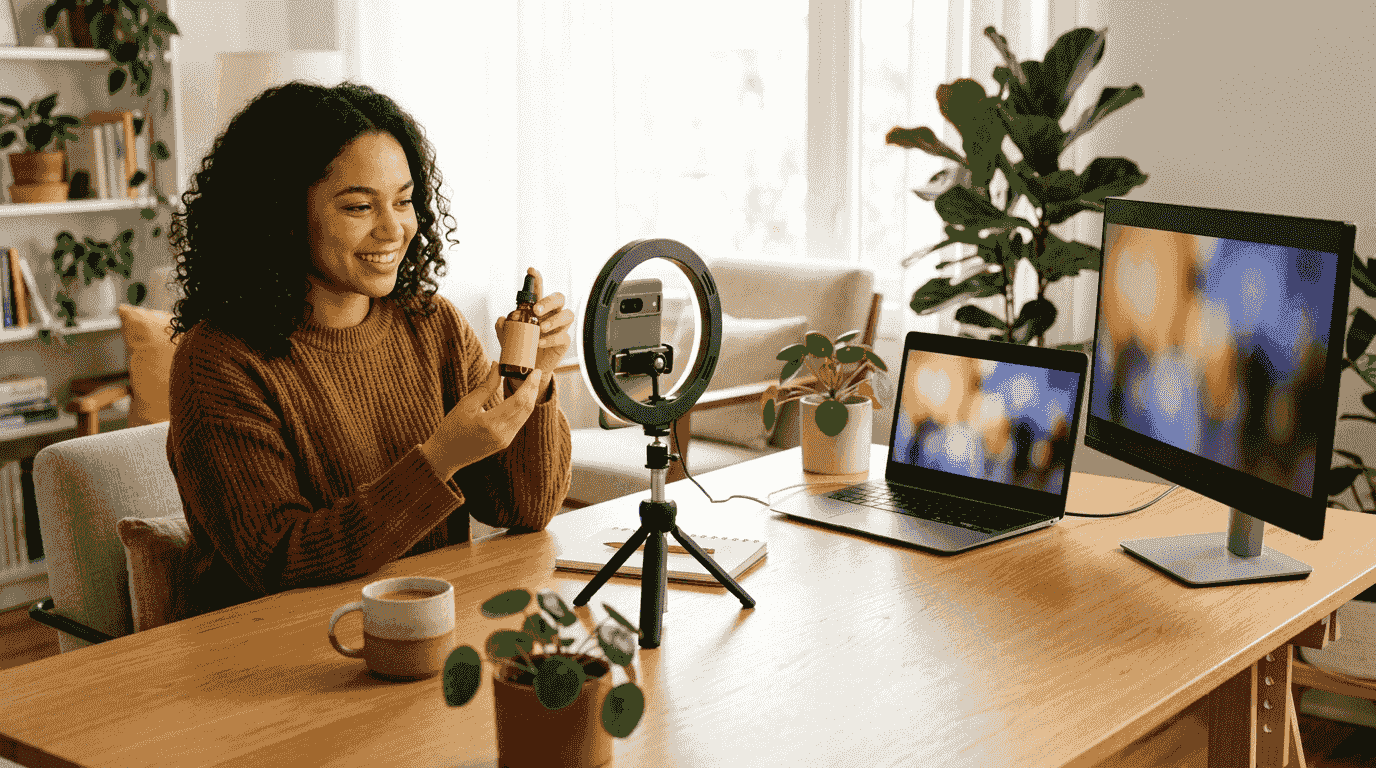
This is the central matchup, so be precise about it. Real UGC is a person who looks like the viewer, in a real kitchen or car, saying something that sounds unscripted. The things that make it convert are micro-expressions, an off-beat pause, a genuine reaction to the product. AI UGC, today, flattens those. Synthetic avatars have gotten good at lip-sync and mediocre at being believable, and a feed-native audience clocks the difference in the first second. On testimonial, founder-to-camera, and "why I switched" angles, real UGC still beats AI UGC on raw conversion. If you need a face to carry trust, hire the face.
Physical product demonstration
If the ad has to prove something physical, you need a camera. AI can stage a plausible scene of a generic product, but it cannot show your specific item behaving in the real world: the actual texture, the real fit on a real body, the tool doing the thing it claims to do. Demo-led categories like food, apparel, and hardware lean human for the hero shots and use generated b-roll to fill around them.
Original creative strategy
A good creator brings a point of view: a structural idea your competitors haven't copied, a cultural reference timed to this week, a hook that breaks pattern. Models are excellent at executing a known formula and weak at inventing one. That's a structural limitation, not a tuning problem, because a model is averaging over what already worked. Breakout creative lives at the edge of the distribution, and that's where a sharp human still outruns the machine.
Will AI replace UGC creators and video editors?
This is the question the comparison keeps circling, so answer it directly. AI will not replace UGC creators and video editors as a category, but it is already replacing a slice of what they used to be hired for.
For UGC creators, the work that disappears is the low-stakes, high-volume stuff: forty near-identical hook variations, generic product b-roll, the explainer where nobody needs to see a face. The work that survives, and gets more valuable, is anything that depends on being a credible human on camera. The market is splitting into "filming a believable person" (safe, arguably scarcer) and "producing volume" (going to software).
For video editors, the same split applies. Templated cutdowns and format resizing are being automated. Editors who only resized 16:9 into 9:16 are exposed, because AI reframing now does that conversion in one click while tracking the subject to keep it centered. Editors who shape narrative, fix timing on a hero spot, and bring taste to a scaled winner are not. The honest read is that AI doesn't replace the role, it eats the bottom of it and raises the bar on the top. If you're a creator, the move is to be the person AI can't fake.
AI ad generator vs UGC creator: how to route the job
For most operators the answer to AI ad generator vs UGC creator isn't either/or. It's a sequence. Use the generator to find the message, then put a human behind the message that won.
- Discover with AI. Render ten to twenty cheap variants across hooks and angles. Let the platform tell you which message and structure actually pull, for the cost of an afternoon.
- Scale the winner with a human. Take the proven angle and commission one high-craft UGC video or a properly edited spot to put real spend behind.
This inverts the common and expensive mistake, which is to buy the polished human version first, on an unproven angle, and discover it doesn't convert after the money's gone. Validating the brief with cheap AI variants is how you de-risk before anyone ships you a product or picks up a camera. If you've already decided the job is purely about volume and you're weighing tools against people, the deeper version of this lives in AI ad tool versus a freelancer and AI generator versus an agency.
One thing that decides quality on both sides of the routing: the brief. Whether the output comes from a model or a person, vague input produces forgettable ads. A tight creative brief that names the target's existing belief, spells out the literal first line, makes one concrete claim, and picks a single call to action will lift the output of a generator and a UGC creator by the same margin. Hand both the same brief and you finally get an apples-to-apples read on which one performs for your account.
The trade-offs you're actually signing up for with AI
Choosing AI for the testing phase comes with real costs, not just upside.
- Sameness. If everyone runs the same generators, the ads start to rhyme. Your edge has to come from the script and the offer, because the production no longer differentiates you.
- Brand drift. A URL scrape captures the gist of your brand, not its edges. The generated script is a strong first draft; plan to rewrite the lines that sound like a robot read your homepage.
- The avatar tax. A synthetic presenter still underperforms a real face on emotional and testimonial angles. For those, skip the avatar and build the ad around generated scenes instead of a fake person.
- Disclosure rules. Some platforms expect AI-generated content to be labeled. Check the policy for your category before you scale spend behind it.
None of these are reasons to avoid AI. They're reasons to use it as the fast, cheap front end of your creative process and to keep human judgment, and human faces, for the parts that depend on them.
Sources
- Billo — UGC Rates in 2025: What Brands Actually Pay (Why It Varies)
- CutJamm — Freelance Video Editing Rates
- Genra.ai — The Real Cost of AI Video vs Traditional Production: A 2026 ROI Breakdown
- Wonderful — Meta's Andromeda Update: 11 Creative Strategies for DTC Brands in 2025
- OpusClip — AI Reframe: Auto Video Resizing in 1 Click
The practical takeaway: stop framing it as AI versus a human and start using AI to find the winning angle for the price of an afternoon, then decide whether that winner has earned a human production budget. Aitachyon is the generator side of that workflow, built to make the volume-and-speed half cheap enough that the comparison stops being a guess and becomes a number.
Related articles
The one-person ad agency is here
One operator, ten clients, $1.20 per video in production. The margin math of the one-person ad agency, the stack that holds it, and the honest ceiling.
TrendsText to Video Ads in 2026: Sora, Veo, Runway & Kling Compared
A practitioner's guide to which text to video ads models hold up for paid creative in 2026, and where Sora, Veo, Runway and Kling break.
StrategiesRetargeting Ad Creative: What to Show the People Who Bounced
Retargeting ad creative needs a different message than prospecting. The objection, proof, and urgency shifts that recover lost carts and cold leads.
GuidesVideo ad hooks that survive the first second: 18 patterns
18 video ad hook patterns grouped by mechanism, with examples, and why TikTok ad hooks belong in the spoken first words, not the text overlay.
TutorialsHow to Make AI Ads That Don't Look AI (500M-Impression Data)
AI ads that don't look AI beat both human and obvious-AI creative across 500M impressions. The exact tells to remove, ranked by what gives you away.
StrategiesBrand Consistency in Ads: A Brand-Kit System for 50 Variants
A brand kit for ad creative—locked colors, type, voice, and do-not rules—that holds brand consistency in ads across 50 variants without per-asset review.
Free tools to try
Free AI art generator
Turn a prompt into striking AI art across any style, from oil painting to anime to digital concept work. Free to try, no account needed, keep your first artwork on signup.
Try it freeFree toolFree AI image generator
Describe what you want and get a high-quality AI image in seconds. A free AI image generator, no account needed to preview, keep your first image when you sign up.
Try it freeFree toolFree AI product photo generator
Generate clean, studio-style product photos for your store and listings in seconds. Crisp lighting and tidy backgrounds, free to try with no account, keep your first shot on signup.
Try it freeStop describing your brand. Paste your URL.
Aitachyon reads your whole brand from your website, then creates videos, images, carousels, posts and banners, on-brand, every format, every feed.