AI Ad Tool vs Freelancer: When a Video Editor Still Wins
AI ad tool vs freelancer, decided by editor rates, revision rounds, turnaround, and how many short-form video variants you actually need each month.
AI Ad Tool vs Freelancer: When a Video Editor Still Wins
A skincare brand I watched scale had one freelance editor on retainer. He was excellent. He also became the reason their TikTok account stalled for six weeks. They had three winning hooks they wanted to spin into a dozen variants each, and his queue could absorb maybe four edits a week. The creative wasn't the problem. The single editor was the throughput limit, and no amount of talent fixes a one-person pipeline that needs to ship thirty cuts. That is the heart of the AI ad tool vs freelancer decision, and it almost never comes down to who makes the prettier video.
This piece is specifically about a freelance video editor: the person you hire on Fiverr, Upwork, or by referral to cut, caption, and format short-form ads. Not a strategist, not an agency. If you are weighing a full shop with account managers and a creative director, the AI tool versus agency math works differently. Here, the comparison is narrower and more concrete: one contractor with an hourly rate and a revision policy, versus a subscription that turns a brief into a finished cut on demand.
What a freelance video editor actually does (and what they charge)
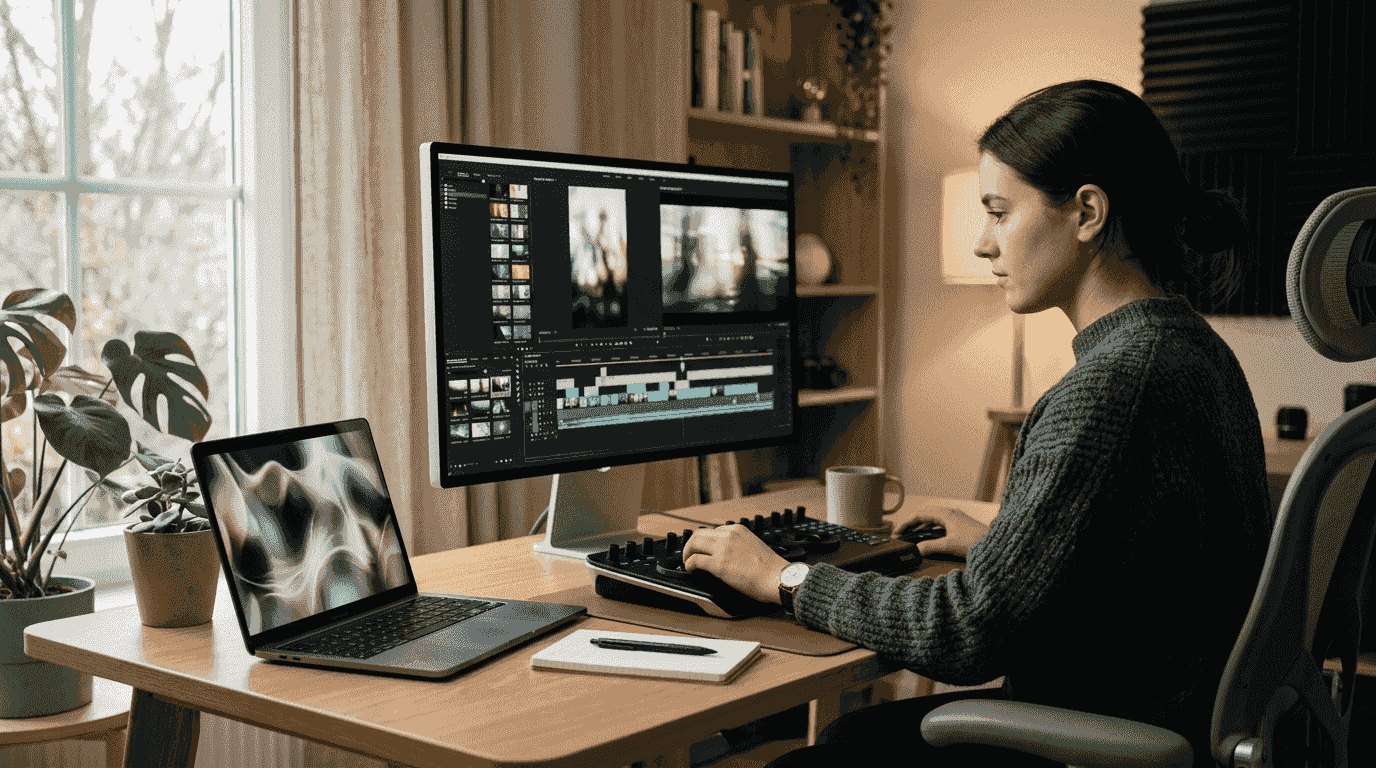
Before comparing, it helps to be precise about the job. A freelance short-form editor takes your raw footage or a rough idea and delivers a paced, captioned, music-bedded vertical video sized for the platform. That is a real craft: timing a cut to a beat, building a caption rhythm that holds attention, color-matching clips from three different phones. It is not the same job as writing the script or deciding the angle.
The rates are knowable, not mysterious. On the lower end of the market, short-form social edits on Fiverr commonly run somewhere in the $20 to $80 band per video for a basic 15 to 30 second cut, often with a defined revision cap; independent rate guides put a beginner short at $25 to $75 per short, in line with the low end of that range. Experienced editors on Upwork or working independently usually quote hourly rates roughly in the $25 to $75 range, and a single polished ad can eat two to four billable hours once you count syncing, captioning, and exports. Retainers for someone reliable who learns your brand tend to land in the low four figures a month for a fixed deliverable count. A per-video quote typically bundles one or two revision rounds; a third round is a new line item.
Those revision terms matter more than the headline price. Most freelance contracts give you one or two rounds of changes before extra edits are invoiced as a separate line item. That is fine when you are refining one good asset. It becomes a tax the moment your testing plan calls for many small variations.
The three things that actually decide it
Feature lists will not help you here. Three variables do, and they interact.
- Turnaround. A solo editor with other clients realistically delivers a first cut in one to three business days, plus a day per revision round. An AI ad tool returns a captioned cut in minutes. For a single asset that gap is irrelevant. For a daily test loop it is everything.
- Revision type. There is a difference between "shift the captions and tighten the first second" and "this whole pacing approach is wrong." An editor absorbs the first kind easily and charges for the second. A tool regenerates either kind instantly, but only within the patterns it knows.
- Asset volume. One hero cut a quarter is a freelancer's natural home. Twenty disposable variants a week is not.
An editor is strong on revision nuance and weak on volume. A tool is the reverse. Hold those two truths and most of the decision answers itself.
When the freelance editor is clearly the right hire
There are jobs where paying an editor is the obvious move, and using a tool instead would be a false economy.
You are cutting real footage
If you have a founder talking to camera, genuine product footage, or location b-roll, you need someone who can edit that material. Color, audio cleanup, matching shots from different cameras, trimming a forty-minute recording into a tight thirty seconds. Generative tools can fabricate AI avatars and synthetic b-roll, but they are poor at editing your actual footage with judgment. When the raw material is real, the editing is real work.
The asset has a long life
A homepage hero video, a launch film, a YouTube pre-roll that will run for months. These get seen thousands of times and represent the brand. The marginal hour an editor spends on a frame-accurate transition pays off because the asset is durable. AI economics reward disposable creative, and a flagship film is the opposite of disposable.
The edit needs taste, not just assembly
Some cuts depend on a human noticing that the energy dips at second four, or that the music swells half a beat too late. That sensitivity to rhythm is exactly what you are paying a good editor for, and it is the clearest line in the broader AI versus human creator comparison. A tool produces competent pacing. It does not produce taste.
When the AI ad tool wins instead
Now flip the situation. The single-editor model strains badly in the cases founders running paid social hit most often.
Variant volume for the feed
Meta and TikTok reward feeding the system many angles and letting it surface the winner. In practice that means you do not want one great ad; you want fifteen serviceable ones and a way to make more next week, which is the logic behind a deliberate creative volume strategy. Asking a freelance editor for fifteen cuts a week means fifteen line items, two or three revision rounds each, and a queue that backs up by Wednesday. You would be paying craft rates for assets engineered to be killed within days.
The tight iteration loop
When a variant shows promise, you want five derivatives of it tomorrow: same body, new first second, new caption, new end card. A tool runs that loop the same afternoon. An editor with a multi-day turnaround and a revision cap cannot keep pace, and that delay is precisely why iteration speed is the real moat in paid social.
Testing before you have a winner
Early on, every dollar spent on editing polish is premature. You are buying signal about which hook lands, not a finished artifact. Cheap and many beats slow and beautiful until something earns the budget for craft, and a side-by-side look at the best AI ad tools shows how cheaply that testing layer now runs.
AI vs a Fiverr or Upwork editor: the cost crossover
The cost-to-hire-a-freelance-video-editor question gets framed badly. People compare a single per-video quote to a monthly subscription and stop. The variable that actually decides it is how many videos you will make.
An editor's cost scales linearly. At a midpoint per-short rate of, say, $50 a cut, ten videos cost roughly $500, twenty cost roughly $1,000, and that climbs every month you keep testing. A subscription tool is flat against volume: the second cut and the fortieth cost the same. So the crossover is real and it is not subtle.
- One to three videos a month, craft matters: a Fiverr or Upwork editor is often genuinely cheaper and better, and the human eye on a hero asset is worth it.
- Ten or more variants a month, most disposable: the per-video math collapses in the tool's favor, and the revision rounds you would have paid for stop mattering because you simply regenerate.
One thing the linear-versus-flat picture hides: an editor learns your brand over time, so video number twenty from a retained freelancer is often better than video number one. A tool's twentieth output is about as good as its first. If brand consistency across a long relationship is the goal, that learning curve is a point for the human that raw price ignores.
When your freelancer is the bottleneck vs when AI is
Because this is a single-contractor relationship, the failure modes are specific. You are not managing a team; you are depending on one person's calendar and one tool's limits. Here is how to tell which side is constraining you right now.
Your freelancer is the bottleneck when: you have approved concepts sitting in a queue, your test plan calls for more cuts than they can deliver in a week, their out-of-office derails your launch calendar, or you find yourself trimming the test plan to fit their availability rather than your strategy. If you are editing your ambitions down to match one person's bandwidth, the editor has become the ceiling.
The AI tool is the bottleneck when: your variants are starting to look like each other, the generated voice or avatar is undercutting trust on a high-consideration product, you need to cut footage the tool cannot touch, or the output captures your surface brand but misses the specific way you actually want to sound. A few habits for making AI ads that do not look AI-generated push the first problem back, but the others are signals to bring a human in for that particular asset.
The practical move is not to pick a side for life. It is to notice which constraint you are hitting this month and route the work accordingly. Volume testing to the tool, the asset that needs real editing taste to the freelancer.
A few honest edges of each
A fair decision needs the limits of both, not a pitch for either.
- Tools drift toward sameness. Trained on common ad patterns, they produce ads shaped like common ad patterns. The counter is angle diversity and volume, not more polish.
- Synthetic presenters have a ceiling. Lip-sync and generated voiceover are usable for top-of-funnel, but on a high-trust purchase they can read as off and quietly cost you credibility.
- An editor is not a strategist. A great cut of a weak offer is still a weak offer. Neither a tool nor a video editor will tell you the problem is your positioning; that is a different hire.
- Freelancers are a single point of failure. One person gets sick, takes a holiday, or raises rates, and your entire creative pipeline pauses. A subscription does not take vacations, but it also does not learn your brand the way a person does.
Two questions founders ask about this exact tradeoff
How much does a freelance video editor charge per ad?
For a short-form social cut, expect roughly $20 to $80 per video on Fiverr for a basic edit with a capped revision count, and meaningfully more from experienced editors quoting hourly, where a single polished ad can total $100 to $300 once you account for the hours a short ad creative actually takes. Retainers for a reliable editor who learns your brand usually run in the low four figures a month for a set deliverable count. The number that surprises people is the revision tax: most quotes include one or two rounds, and conceptual reworks are billed as new work rather than tweaks.
Can AI handle the revisions I would normally send a freelancer?
It depends on the kind of revision. Surface changes are where AI shines: swap the caption styling, shorten the open, change the end card, regenerate the whole thing in a different aspect ratio. Those are instant and unlimited, with no round counting against you. What it handles poorly is the conceptual note an editor absorbs through experience, like "make the energy build instead of front-loading it" or "match the grade on these two clips." Those still want a human. The rule of thumb: if your revisions are variations on a theme, the tool covers them; if your revisions require taste applied to real footage, send them to the editor.
The short version
The AI ad tool vs freelancer choice is not a quality contest, it is a fit question. A freelance video editor is the right call when you are cutting real footage, building a durable asset, or buying editing taste, and your monthly volume is low enough that linear per-video cost stays reasonable. A tool is the right call when you need many variants fast, your iteration loop is daily, and most of your output is disposable test creative. Match the spend to the job in front of you, and watch which one is actually slowing you down.
Sources
- Upwork — Video Editor Hourly Rates and Cost to Hire a Video Editor
- Fiverr — How Much Does a Video Editor Cost?
- Pixflow — Video Editing Pricing Guide 2026: Freelance Rates That Work
- Twine — Video Editor Rates Guide: Average Hourly Rates and Cost Factors
- Creativize — Freelance Video Editing Rates in 2025: Top 7 Pricing Models
- WaffleInvoice — How to Invoice as a Video Editor (Rates, Revisions, and Licensing)
If that bottleneck is volume and speed rather than craft, Aitachyon exists to take the variant-and-iteration layer off your editor's queue, so the human time you do pay for goes to the assets that genuinely deserve it.
Related articles
4K Product Image Generation with Seedream 5.0: When You Actually Need It
What a 4K Ultra image tier on Seedream 5.0 unlocks for your brand, how to turn on the opt-in 4K option, and when full 4K is worth the extra credits versus the standard generation.
ToolsCreative Ops Stack for Performance Marketing: The 2026 Minimal Setup
A creative ops stack for performance marketing built on four jobs—brief, production, delivery, analytics—so a lean team ships ad variants at volume.
ToolsAI Ad Generator vs Agency: What You Actually Get for Your Money
AI ad generator vs agency, costed line by line: cost-per-asset, turnaround, and what a $79/mo tool and a boutique retainer each actually buy.
ToolsBest AI Ad Creation Tools in 2026: 7 Tools Compared on Real Output
A hands-on comparison of the best AI ad creation tools in 2026, scored on real output quality, pricing, and metering, not the demo reel.
TrendsAI vs Human Video Ad Creators: What Each One Actually Beats
AI vs human video ad creators compared on cost, speed, trust, and demos, plus where AI ads beat real creators and where humans still win.
StrategiesVideo Ad Production Speed: Why Iteration Velocity Beats One Winner
Video ad production speed, not a single hero creative, decides paid-social outcomes. Here is the math on iteration velocity and how to make ads faster.
Free tools to try
Free AI product photo generator
Generate clean, studio-style product photos for your store and listings in seconds. Crisp lighting and tidy backgrounds, free to try with no account, keep your first shot on signup.
Try it freeFree toolFree AI image generator
Describe what you want and get a high-quality AI image in seconds. A free AI image generator, no account needed to preview, keep your first image when you sign up.
Try it freeFree toolFree background remover
Remove the background from any image in seconds and get a clean, transparent cutout. A free background remover, no account needed to preview, keep your first cutout when you sign up.
Try it freeStop describing your brand. Paste your URL.
Aitachyon reads your whole brand from your website, then creates videos, images, carousels, posts and banners, on-brand, every format, every feed.