A/B Testing Video Ads: Test One Variable and Reach Significance on a Small Budget
A/B testing video ads on a small budget: isolate one variable, hit real sample thresholds, and read significance without fooling yourself.
A/B Testing Video Ads: Test One Variable and Reach Significance on a Small Budget
Before you build a single variant, write one sentence describing the exact difference between version A and version B. If that sentence needs a comma and the word "and," you do not have a test yet. That one rule is what separates A/B testing video ads from running two unrelated creatives and guessing afterward: change one thing, measure the right layer, and wait for enough data to mean something.
This matters more on a small budget than a large one. A team spending $5,000 a day fills a thousand clicks before lunch and can absorb a sloppy test; on $20 to $50 a day, a comparison that confounds four variables wastes impressions you cannot spare. Precision is how low spend pays for itself in learning.
A/B testing video ads starts with changing one variable
If A and B differ in hook, music, length, and call-to-action, and B wins, the result is uninterpretable. You cannot tell which change drove the lift, so you cannot carry it forward, and the next ad starts from zero. Hold everything constant except the one element you are testing.
For video, here are the variables worth isolating, ordered by how much they move the result. Test from the top down, because a sharp call-to-action on an ad nobody watches past second two changes nothing.
- Hook (first 2-3 seconds). The highest-leverage variable, since most of the audience that will leave does so before the first scene change. Keep a stash of scroll-stopping opener templates ready to feed into a test.
- Offer or angle. The problem you lead with or the promise you make: "Reconcile a month of invoices in ten minutes" versus "Stop chasing late payments" for the same product.
- Length. 6s versus 15s versus 30s. Short cuts win on reach and CPM; longer cuts can win on qualified clicks when the product needs explaining, and the optimal length shifts by platform.
- Format and aspect ratio. 9:16 for Reels, TikTok, and Shorts; 4:5 or 1:1 for feed; 16:9 for in-stream. Same creative, different frame.
- Voiceover versus captions only. Feed plays sound-off by default, so on-screen text often carries more weight than narration in those placements.
- Call-to-action. "Shop now" versus "Learn more" versus "Start the free trial." Lowest impact, but cheap to test once the rest is locked, with many CTA formulas to cycle through.
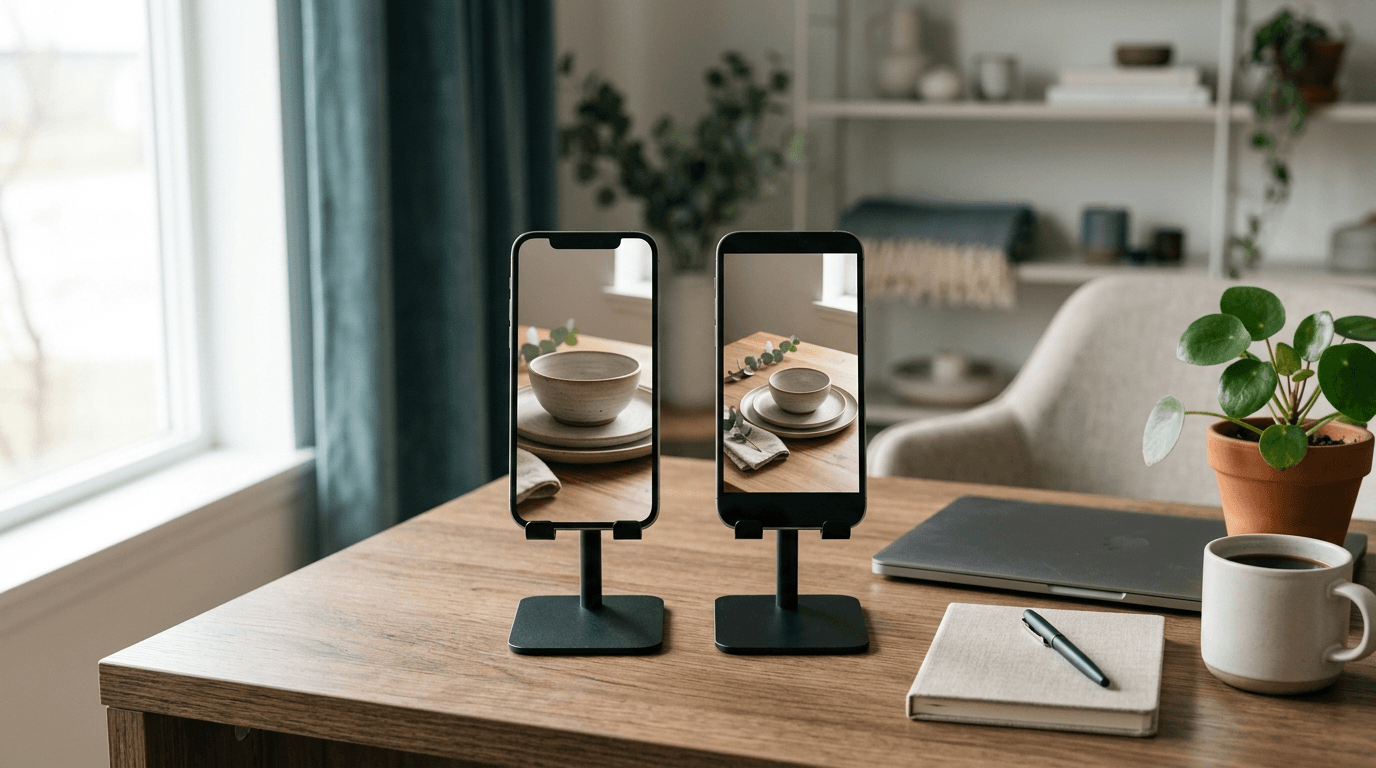
Split test vs A/B test: same idea, different labels
Split test and A/B test describe the same experiment: two or more variants of one element, traffic divided between them, the better performer kept. Meta calls its native tool "A/B Test"; TikTok calls its version "Split Test." The difference is branding, not method. What does differ is a multivariate test, which changes several variables at once and needs far more volume to resolve, so it does not belong on a small budget.
Statistical significance on a small budget
Statistical significance asks whether the gap between two ads is real or just random scatter you would see even if the ads were identical. The formal version uses a sample size calculator and a confidence threshold, usually 95 percent. You will rarely run that math mid-campaign, so the workable substitute is a set of sample floors that stop you calling a winner too early.
Per variant, before you trust a comparison:
- 1,000 impressions is the floor for directional signal only. It shows a variant is not broken; it decides nothing.
- ~100 link clicks per variant before a click-through-rate comparison means anything. Under that, a few stray clicks swing the rate by a full point.
- ~50 conversions per variant before a cost-per-acquisition comparison holds up. Most small budgets never reach this per variant, which is why you judge tests on upper-funnel metrics that fill faster.
A worked example: when 3.1% beats 2.4%, and when it does not
Variant A shows a 2.4 percent CTR, variant B shows 3.1 percent. That looks like a win for B; at 1,000 impressions each it is not. Clearing 95 percent confidence at a 2.4 percent baseline needs a margin of roughly 1.4 to 1.5 points, far wider than the 0.7-point gap you have. That is only about 31 clicks for B against 24 for A, so three or four clicks landing differently erases the lead.
Run the same two rates to 12,000 impressions each and the picture flips. B now has roughly 372 clicks, A roughly 288, and a 0.7-point gap clears the 95 percent bar comfortably. Identical rates, opposite verdicts; only the denominator changed. The same difference is meaningless at a thousand impressions and a decision at twelve thousand, and the job is knowing which one you are looking at before you move spend.
Match the metric to the budget you have
Conversions are the slowest signal to accumulate, so on low spend judge the test on the earliest reliable proxy and confirm at the account level later. Picking which metrics actually predict winners matters, because A/B testing CPA directly on $20 a day usually means calling a winner on three purchases:
- Hook tests read on 3-second views and hook rate (3s views divided by impressions). Hundreds land within hours.
- Body and length tests read on watch-through rate (the share reaching 50 or 75 percent) and CTR.
- Offer and angle tests read on CTR and cost-per-click, with CPA confirming once volume builds.
Set up the experiment so delivery does not corrupt it
Meta and TikTok both optimize delivery inside a campaign, which breaks naive tests. Drop two ads into one ad set and the algorithm picks a favorite within hours, then starves the other of impressions. Your test becomes the algorithm's early guess on a sample smaller than you would accept.
Meta A/B Test vs TikTok Split Test
The clean fix is the platform's own experiment tool, which splits the audience into non-overlapping slices so each variant gets an independent read:
- Meta A/B Test. Found under Experiments in Ads Manager, or as a toggle when you duplicate a campaign or ad set. A Facebook ad split test run this way stops delivery from cannibalizing one variant by dividing the audience into random, non-overlapping groups, and Meta reports a winner once it finishes. It is the correct default on Meta and Instagram placements.
- TikTok Split Test. TikTok's split testing tool, available when you create a campaign, partitions the audience the same way and lets you test creative, audience, or bidding. Pick creative for video work and fix everything else.
If the experiment tool is overkill, the manual alternative is one ad per ad set, equal budgets, identical audience and placements. Either way, hold audience, placements, bid strategy, budget, and launch time constant, and start both at the same hour. Day-of-week and time-of-day effects distort early numbers more than most people account for.
Reading results without fooling yourself
Three traps cause most bad calls once the data lands.
Peeking and stopping early
Check the dashboard every hour and stop the instant a variant pulls ahead, and you will "discover" winners that are pure variance, because each peek is another chance for noise to cross your line. Set a stop point before launch and hold to it. Early leads reverse constantly in the first 48 hours while delivery is still learning.
Judging on the wrong layer
A hook test "won" by a 9:16 cut might only mean 9:16 drew cheaper placements that day, not that the hook performed. Confirm the metric you read reflects the variable you changed: for a hook test, that means 3-second views and thumb-stop rate, not a final CPA three layers downstream.
Ignoring the cost twin
A higher CTR paired with a higher cost-per-click can still be the worse ad. Read every rate alongside its cost: CTR with CPC, conversion rate with CPA. A variant that wins engagement while costing more per outcome has not actually won.
A flat test, where no variant clears your margin, is a finding too: this variable does not move the result for this audience right now. Keep the incumbent as control and move to the next variable up the list.
Why test throughput decides the outcome
Significance math rewards repetition, so the rate at which you ship clean tests is what compounds. If one in four tests yields a confirmed improvement, a buyer running twelve single-variable tests a month banks three real wins while one laboring over two "perfect" creatives banks half a win, and every winner becomes the control for the next round. That is the case for treating iteration speed as a competitive edge. The binding limit is usually production, not analysis: when each variant takes a day to edit, you run too few tests to climb the curve.
Common questions about A/B testing video ads
How long should I run a Facebook or Meta ad test?
Run at least 3 to 4 full days to cover weekday and weekend behavior and let delivery exit its learning phase, but do not stop until each variant clears its sample floor of roughly 100 link clicks for a CTR read. On small budgets, sample size binds more often than time.
How do I check statistical significance without a calculator?
One quick check: would adding a single click or conversion to the trailing variant flip the result? If yes, keep running. For a number, a free A/B test sample size calculator gives the per-variant clicks needed for your baseline rate and minimum detectable effect. A practical shortcut on small budgets is to require a 15 to 25 percent relative gap before calling a winner, since a margin that wide is hard for noise to fake.
Can I test more than two video ads at once?
Yes, but each extra variant splits the budget further and takes longer to reach a usable sample. Two or three variants of a single variable is the sweet spot, the same trade-off that governs how many ads to run at once. Never combine a hook test and a length test in one experiment, or you are back to a confounded result you cannot reuse.
Sources
- AB Tasty — A/B Test Sample Size Calculator (95% statistical significance standard)
- Meta for Business — A/B Testing Ads on Facebook and Instagram
- TikTok Ads Manager — About Split Testing
- OpusClip — TikTok Hook Formulas That Drive 3-Second Holds
- Bestever — Meta Video Ad Specs: Sizes, Formats, and Placements
Disciplined A/B testing video ads depends on producing near-identical variants cheaply: change the hook, hold everything else fixed. Aitachyon returns three script variants per run, each exported in 9:16, 16:9, and 1:1, enough to assemble a clean one-variable split without a production day behind every cut.
Related articles
Video Ad Approval: The Meta and TikTok Policy Traps That Get You Rejected
A media buyer's guide to video ad approval—the exact phrases, visuals, and gated categories that get Meta and TikTok ads rejected, and how to reframe.
TutorialsHow to Make AI Ads That Don't Look AI (500M-Impression Data)
AI ads that don't look AI beat both human and obvious-AI creative across 500M impressions. The exact tells to remove, ranked by what gives you away.
TutorialsAI UGC Ads: How to Make Them Look Like Real User Content
How to script, cast, and post-process AI UGC ads so they read as organic creator footage instead of getting clocked as fake on paid social.
TutorialsFrom URL to finished video ad: the two-minute pipeline
Paste a URL, get a finished video ad in about two minutes. A step-by-step look at the pipeline: brand scrape, three scripts, voice, avatar, captions.
TutorialsTestimonial Video Ads With No Customers Yet: 4 Honest Ways
Make testimonial video ads at launch with beta quotes, founder narration, and demo proof, without fabricating reviews the FTC now bans.
TutorialsHow to Repurpose Long-Form Content into Video Ads (Webinars, Podcasts, YouTube)
Repurposing content into video ads the right way: mine 30-second hooks from webinars, podcasts, and YouTube, then restructure them for paid social.
Free tools to try
Free AI art generator
Turn a prompt into striking AI art across any style, from oil painting to anime to digital concept work. Free to try, no account needed, keep your first artwork on signup.
Try it freeFree toolFree AI image generator
Describe what you want and get a high-quality AI image in seconds. A free AI image generator, no account needed to preview, keep your first image when you sign up.
Try it freeFree toolFree AI product photo generator
Generate clean, studio-style product photos for your store and listings in seconds. Crisp lighting and tidy backgrounds, free to try with no account, keep your first shot on signup.
Try it freeStop describing your brand. Paste your URL.
Aitachyon reads your whole brand from your website, then creates videos, images, carousels, posts and banners, on-brand, every format, every feed.